Navigate your job search
with a guide that knows you

An AI job-search tool that starts with understanding the person.
- Solo product design
- Strategy
- Brand
- Build
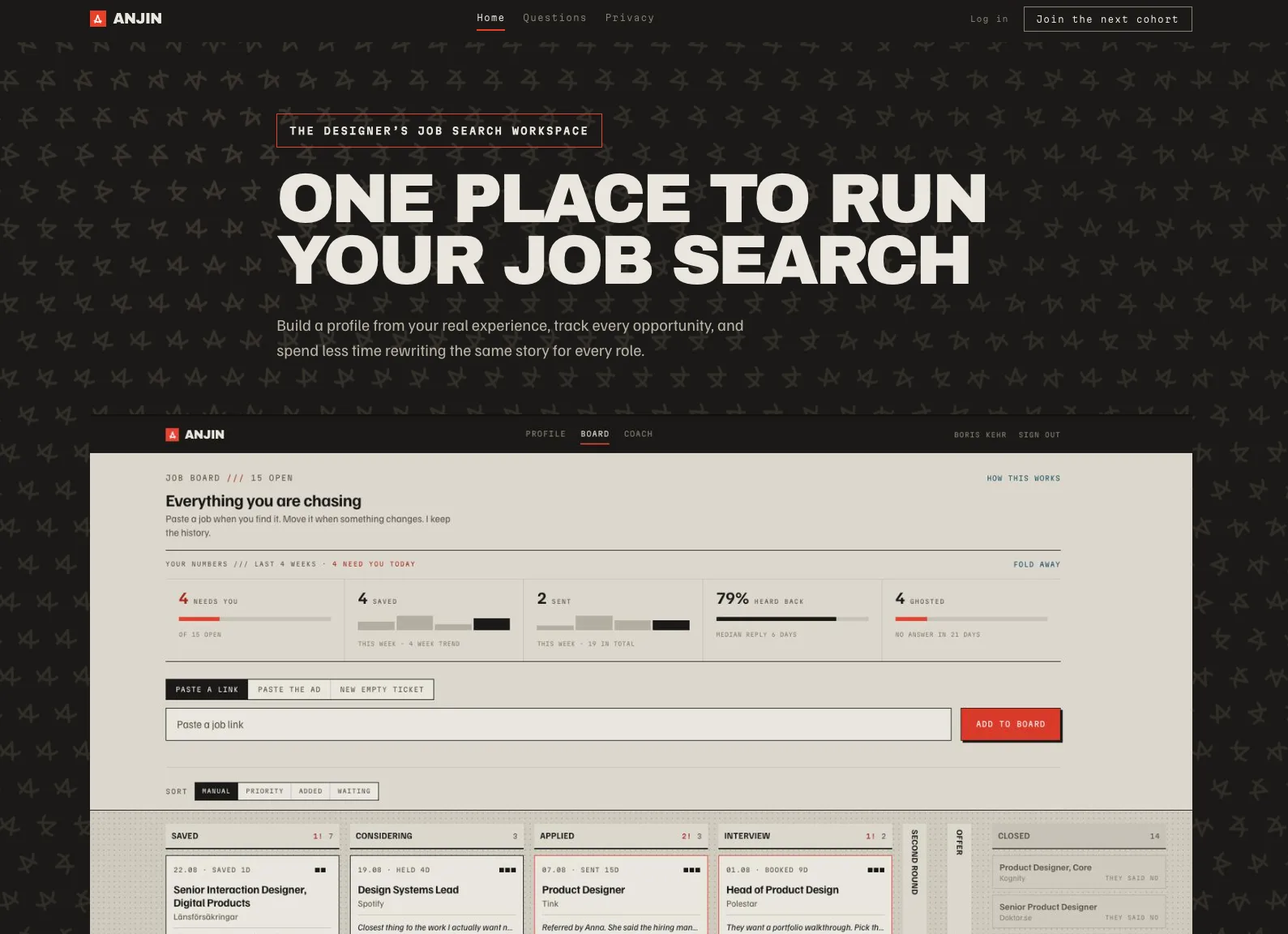
Anjin is a conversational job-search tool that begins with the person rather than the vacancy. It helps people identify how they work, what they are good at and the environments they need, then uses that picture to assess roles and guide the search.
The interview is the product
Anjin starts with a conversation, rather than a questionnaire. Forms can capture facts, but they often stop before the useful detail.
When someone says they enjoy working with people, the next question asks for the moment that made collaboration work. Each answer shapes what comes next: a useful follow-up, a new direction or space to move on.
A profile for judging opportunities
Across the conversation, Anjin builds a working profile of a person’s energy, collaboration style, preferred environments, responsibilities and deal-breakers.
It gives a job description the same context: whether a role fits how someone wants to work, where it matches and where friction may appear. The reasoning stays visible instead of becoming a single compatibility score.
A coach with a clear role
Job searching brings rejection and uncertainty, so the tone cannot be incidental. I designed Anjin as a coach: attentive enough to surface patterns, ask useful questions and offer advice, while leaving decisions with the person.
That means being supportive without performing friendship, and recognising when concerns such as depression or anxiety belong outside a job-search tool. Clear boundaries are product behaviour, not a disclaimer.
Designing beyond the screen
The harder product decisions are behavioural: what Anjin remembers, how it works with uncertainty and contradictions, and when it should advise or ask another question. These choices shape the experience as much as the interface.
Anjin is a prototype, built to make those questions concrete. The next step is testing it with people looking for work: whether they understand its role, where it genuinely helps and which assumptions in the model need to change.