Designing useful help,
right beside the task

Exploring how an AI study buddy could support students inside their existing learning environment.
- Lead Product Designer
- Concept exploration, interaction design and UI design
- Figma
- Concept
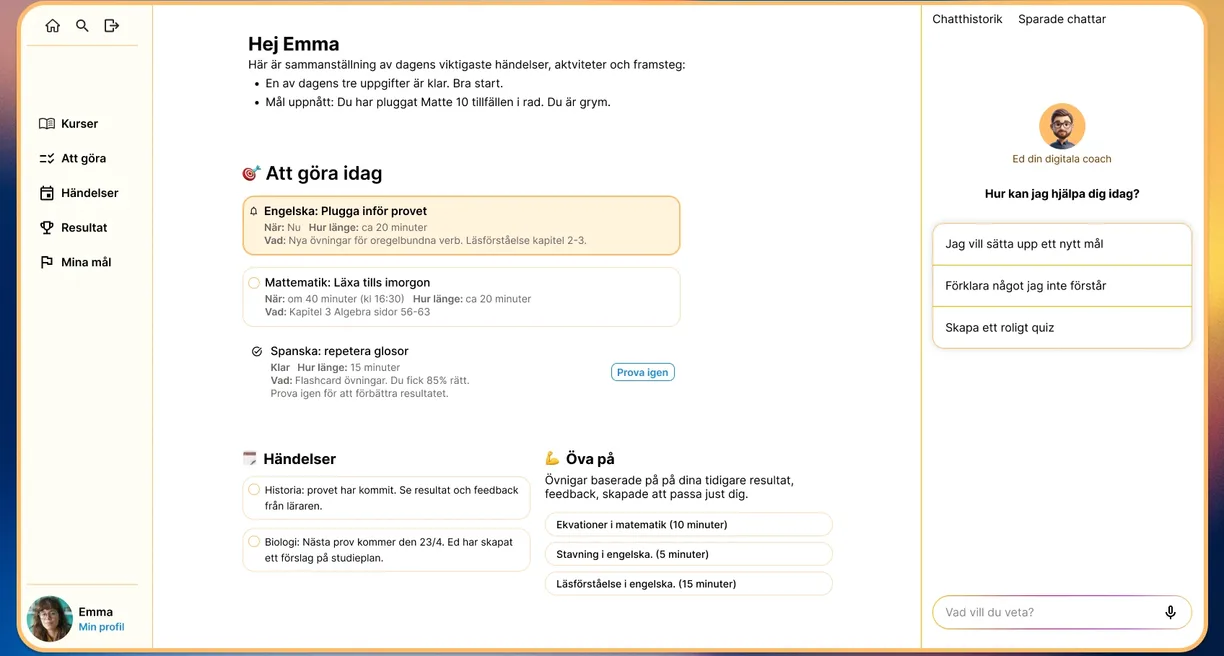
Ed explores how an AI study buddy could support students inside their existing learning environment. I designed the interfaces in Figma, focusing on how the assistant should sit alongside coursework, organise the next steps and offer help relevant to the student’s situation.
A blank chat box leaves the student to find the starting point
A student might arrive knowing they need help, but not knowing what to ask. They may be preparing for a test, struggling with a paragraph or trying to organise the week ahead.
Through research into AI and pedagogy, alongside conversations with teachers and students, I explored two recurring needs: support with structuring work and support with understanding the material.
The design challenge was to make those needs actionable within the learning experience. What should the student see first? How should help relate to the task already on screen? And how could the assistant support progress while leaving the student actively involved?
I designed the interface and the support around it
I translated the learning scenarios into interface concepts and designed the screens in Figma. The work covered the assistant’s position within the learning environment, the hierarchy of tasks and suggestions, and examples of planning, language support and practice.
I used two student scenarios to make the design concrete. Emma needed help turning complex work into manageable steps. Samir needed support understanding and practising material while learning Swedish.
These scenarios gave the interface a practical test: could the student recognise a useful next step in their own situation?
Keep help beside the work
I placed Ed in a side panel alongside the learning environment. The concept lets the student see their coursework and the assistant together, with help connected to the material they are already using.
That creates a hierarchy problem: the assistant needs to be noticeable and useful while leaving room for the learning content. The screen shows how I approached that balance through a separate panel, grouped information and a persistent place to ask for help.
Ed’s panel is my concept design, shown within Google Classroom to illustrate its relationship to the student’s existing workspace.
Make the next step easier to recognise
For Emma, the concept turns an upcoming test into a day-by-day study plan. This makes the work more concrete: a sequence of smaller activities gives her somewhere to begin.
The interface work centres on making that sequence readable. The student needs to distinguish the day, the activity and the supporting explanation without having to interpret everything at once.
Emma’s study plan breaks preparation into smaller activities across the week.
Adapt the support to the student’s situation
Samir’s scenario explores a different need: understanding coursework while learning Swedish. The concept includes translation and language support alongside his daily tasks.
Across the scenarios, I explored a shared role for Ed with different forms of help. Planning supports Emma’s need for structure; language support helps Samir engage with the material. The purpose of the interface is to make the relevant support visible in context.
Emma — structuring her English coursework
Samir — translation and language support
Two scenarios explore how the same assistant could support different learning needs.
Create opportunities to practise
I also explored an exercise that combines listening, speaking and feedback. A student listens to a short story, responds aloud and receives guidance on their answer.
This extends the concept beyond displaying generated text. It introduces a sequence of participation: encounter the material, make an attempt and reflect on feedback.
The screen is an early representation of that interaction. A next design pass would need to resolve the recording states, opportunities to retry and the behaviour when speech is not understood.
A concept exercise connects listening, a spoken response and feedback.
The next step is to test the details
Ed helped me explore how context changes an assistant’s interface and behaviour. Its potential value lies in helping a student recognise and take a useful next step within their learning environment.
The concept still needs testing. I would investigate whether students understand the assistant’s role, can find relevant support and can move between the coursework and Ed without losing their place.
I would then refine the interaction states: how suggestions are dismissed, how students recover from misunderstandings, and how the interface communicates listening, processing and feedback. Those details would determine whether the concept feels dependable in use.