Nobody was the villain

A research report on why hiring leaves candidates and recruiters worse off at the same time, and what that reveals about the system between them.
- Research
- Interviewing
- Synthesis
- Writing
- Design
- Build
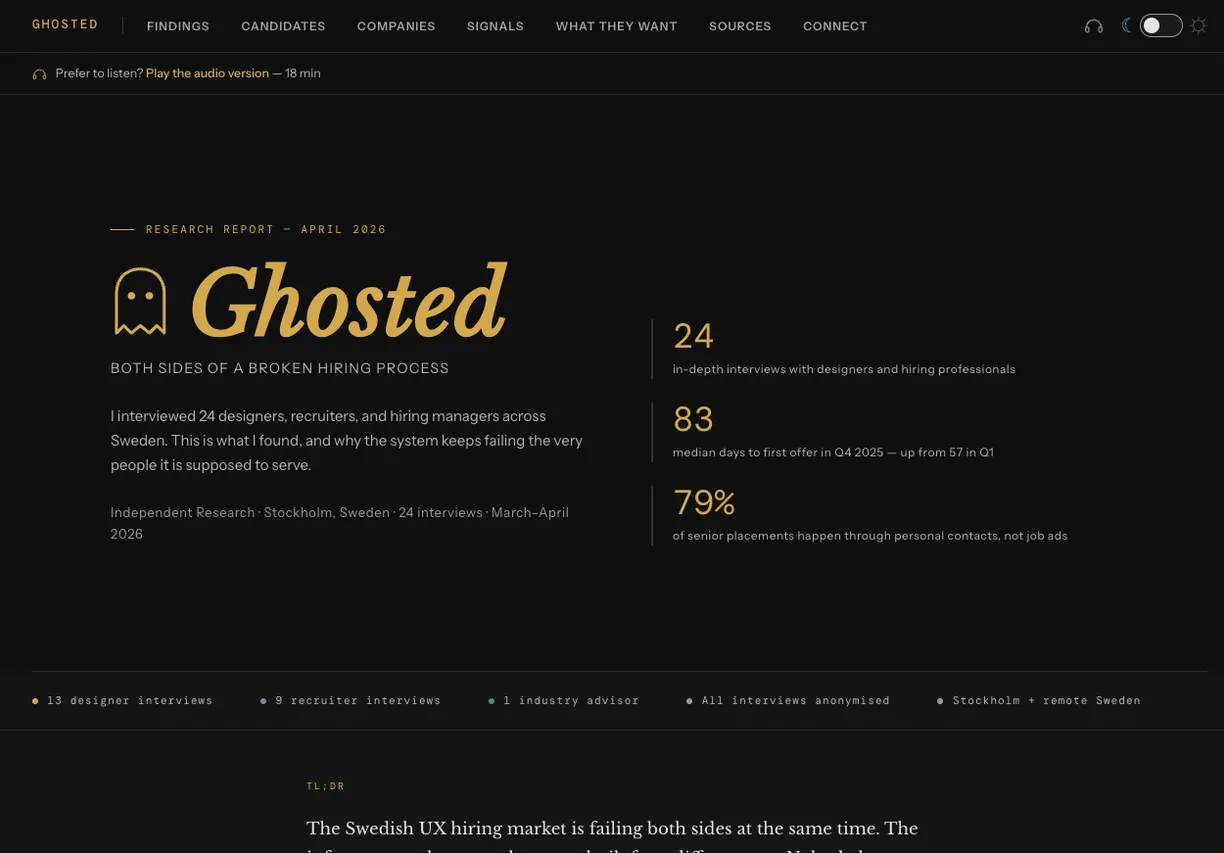
I started with a personal question. After nearly a year of applying, silence and opaque rejections, I wanted to know whether my experience was personal, or structural.
One system, two exhausted sides
Over two months, I interviewed 24 designers, recruiters and hiring professionals across Sweden. I synthesised the findings into a 12-chapter public report, cross-checked them against 10 published sources, and created an 18-minute audio version. I researched, wrote, designed and built Ghosted independently.
The aim was not to prove that every hiring process works this way. It was to make recurring behaviours, tensions and workarounds visible from both sides.
When volume replaces signal
The research revealed a self-reinforcing loop. Recruiters receive more applications than they can assess meaningfully, so they filter faster.
Candidates experience rejection and silence, so they apply more widely. Each side’s rational response makes the other side’s problem worse.
AI accelerated the pattern. Candidates use it to survive automated filtering; recruiters use it to process AI-generated applications. CVs, cover letters and job descriptions become harder to distinguish, while the signals that matter (working style, motivation, values and real capability) become less visible.
The clearest shared principle was simple: AI for logistics, humans for judgment. In practice, hiring often runs in reverse.
What I chose not to solve
I protected the contradictions in the research instead of smoothing them away. When broad surveys presented AI positively but recruiters described it as a noise amplifier, I published the disagreement as a finding.
I also anonymised every participant, even when names or employers might have added authority. Their openness mattered more than borrowed credibility.
Ghosted became the foundation for Anjin, a separate candidate-controlled career product. Its most useful outcome was not a ready-made solution, it was a clearer understanding of what was worth building, and what a product alone cannot fix.
What I learned
I began expecting to find a villain: careless recruiters, entitled candidates or irresponsible automation. I did not find one.
I learned to treat personal frustration as a hypothesis, not a conclusion. In future projects, I will deliberately research the people on every side of a system, look for the incentives shaping their behaviour, and preserve uncomfortable contradictions rather than forcing a simple story.
The strongest product opportunities often sit in the gap between what people say they want and what the current system makes rational for them to do.